The sixteenth century witnessed an extreme surge in book production, introducing some of the most celebrated works and printing houses of our time. The printing of books allowed greater access to the works and commentaries of scholars of the Middle Ages, whilst vernacular literature – language spoken by those of a specific country – was also revitalised, with works modernised by translations into modern prose, though Latin remained the principal language.
During this time, hundreds of printers were trading across Europe, yet what made a printing firm particularly successful was a keen eye for current social and cultural trends, consistent levels of high-quality book production, and an astute sense for business and trade.


During this time, we begin to notice that the physical arrangement of a book becomes more standardised and is similar to how a book might look today, including useful navigational features such as pagination and organised indices. This period also gives rise to the title page, which houses the title and author of the work, the publisher, and often the date. This information, otherwise known as the imprint statement, did not always appear at the front of the book, as before 1500 it mostly appeared on the book’s last page.

If the book trade soared during the sixteenth century, the rate at which it expanded in the seventeenth century is unparalleled. Literacy levels were sharply on the rise, so the production of printed works rose rapidly to satisfy the needs of a demanding reading public, with more diversification in the titles available to include novels and more general works.
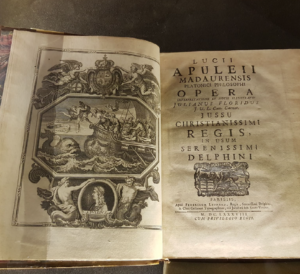
During the seventeenth century, the Low Countries dominated much of the international book trade, though Paris was a close contender. Paris continued to be the leading centre for book trade in France, as in 1620 Louis XIII set up a private press in the Louvre, the Imprimerie Royale, that helped maintain high standards of printing.
Printing during this time also remained concentrated in central and Northern Italy, and Venice remained an attractive location for entrepreneurial printers. Whilst smaller printing establishments had proliferated in the sixteenth century, by the seventeenth century larger firms were increasingly monopolising the trade, such as Elzevier, Plantin and Manuzio.
We are extremely fortunate to have such a widespread, varied collection of rare books at St Hugh’s that span a range of subjects, languages and formats. The books on display here have been carefully selected to highlight some of Europe’s finest, most distinguished printers and booksellers, operating in some of the leading centres for book trade throughout the sixteenth and seventeenth centuries.

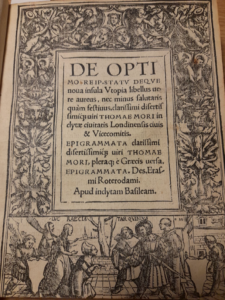
Thomas More wrote his Utopia in Latin, in 1516. He was the first to write of a ‘utopia’, a word used to describe a perfect, imaginary world, deriving the word from the Greek ‘ou-topos’, meaning ‘no place’ or ‘nowhere’. This is often regarded as a pun, being almost identical to the Greek word ‘eu-topos’ which translates in English as ‘good place’. In his novel, More depicts the religious, social and moral customs of the fictional island Utopia, which he uses to comment on and satirise the political and social ideas of the day. The book gives its name to an entire literary genre, utopian fiction, and is arguably a precursor of modern-day science fiction.
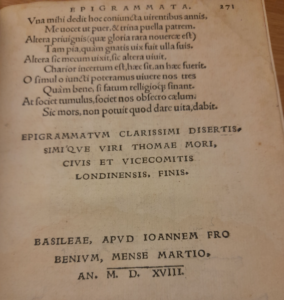
Johannes Froben, one of Basel’s most famous scholar-printers, produced this third edition of Utopia in 1518. Froben popularised the roman type, produced small, cheap books and employed highly talented artists such as Hans Holbein the Younger to illustrate his works. Froben was also a close friend of the great Renaissance scholar Erasmus, who recommended he produce this edition.
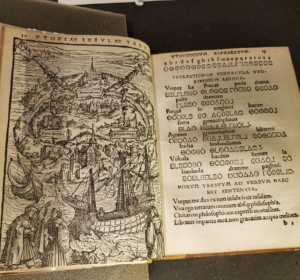
The woodcut illustration map of Utopia displayed here was produced by Ambrosius Holbein, brother to Hans Holbein. It sits next to the 22-letter Utopian alphabet, with letters based on the shapes of the circle, square, and triangle.

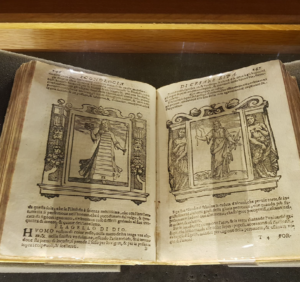
This work is arguably one of the most notable editions of Dante’s Divine Comedy, an allegorical poem describing Dante’s descent into Hell (Inferno), ascent through purgatory (Purgatorio) and elevation into Heaven (Paradiso). It was written by Dante in the early 14th century, yet its influence continued throughout the Italian Renaissance and it has since been heralded as one of the world’s greatest works of literature.


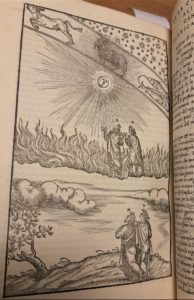
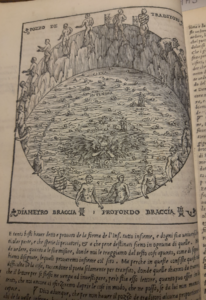
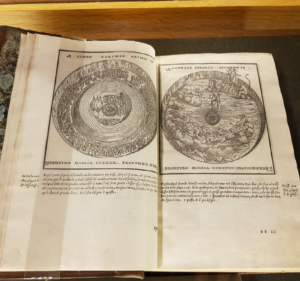
Italian printer Francesco Marcolini issued this edition in 1544, and it was the first to contain the new commentary by Lucchese writer, poet and scholar Alessandro Vellutello. Its visual commentaries take the form of eighty-seven woodcuts, which many consider the most distinctive Renaissance renditions of the work. They marked a major shift in the history of the iconography and reception of Dante’s poem, as Vellutello carefully paired his commentaries with the illustrated woodcuts to help readers interpret the story.
The woodcut illustrations here depict ‘Limbo Cerchio Primo’ (the first circle of Limbo) and ‘Carnali Cerchio Secondo’ (the Carnal, or second circle of Hell).


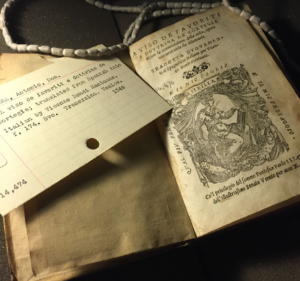
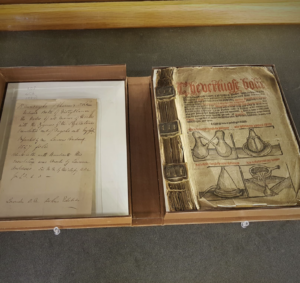
This 1527 English translation of Liber de arte distillandi de simplicibus, first produced in 1500, was written by German surgeon, alchemist and botanist Hieronymus Brunschwig. This was the earliest printed book to discuss and illustrate the techniques of distillation from herbal and animal substances, and, as one of the last fifteenth century herbal books, serves as a notable link between the Middle Ages and early modern notions of medicine.
Laurence Andrew translated and printed this edition in 1527. He was originally from Calais, yet from around 1520, he worked in Antwerp, translating books out of Dutch into English. He then came to London in 1527 where he set up press at ‘the sign of the Golden Cross’ by Fleet Bridge, translating and printing many scientific and encyclopaedic works.
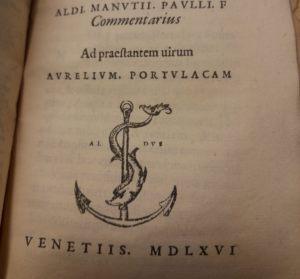
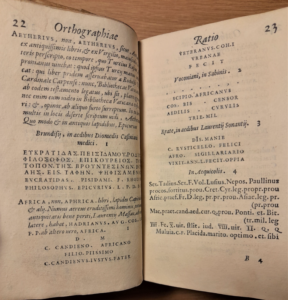
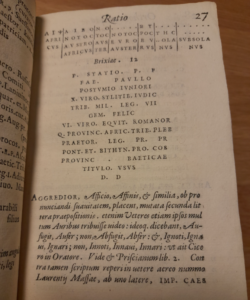
Aldus Manutius the Younger authored this treatise on Latin spelling and grammar in 1561. He was grandson of the highly esteemed printer and bookseller Aldus Manutius and the last of the Manuzio family to be active in the Aldine Press. Its title page shows the Aldine printer’s emblem of a dolphin wrapped around an anchor, inspired by the Latin motto ‘festina lente’, or ‘hasten slowly’.


The Aldine Press is one of the most celebrated printing houses of the period, and their editions stood out for several reasons: they included detailed prefaces that shared and discussed editorial decisions, and engaged readers by encouraging them to find and report errors within. The pages were arranged according to precise mathematical principles, whilst introducing page numbers and using punctuation in ways still used today. The founder, Aldus Manutius, also introduced the first italic typeface as an alternative to the square Gothic print widely used at the time.

Perhaps one of the greatest and most influential creations of the Aldine Press was the printing of books in the small octavo size. These portable books are the ancestors of our modern pocket-sized books and paperbacks today, and paved the way for more personal, intimate forms of reading.
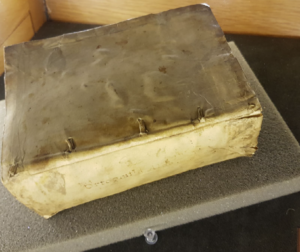
The work has a vellum binding, a parchment mostly made from calfskin, though some were made from sheepskin or goatskin. Vellum was extremely popular at the time for its durability as a binding material, and also as a writing surface for important or official documents.