19 October 2026
St Hugh’s Chefs crowned Oxford Guild of Chefs Five-a-Side champions
St Hugh’s chefs have been crowned champions of the annual City of Oxford Guild of Chefs Five-a-Side ...
Read More
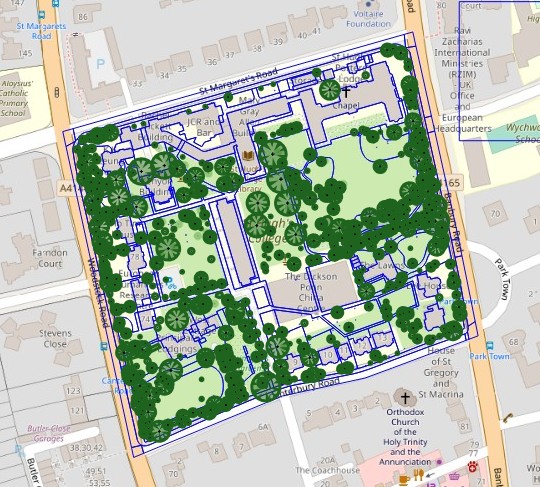
St Hugh’s Head Gardener, Ed Reid, has launched a new tree portal, offering a unique way to explore the College’s beautiful gardens, often described as a mini arboretum, and its impressive collection of trees. The portal showcases the rich history of the College landscape and highlights its continuing importance for biodiversity, learning and wellbeing.
Developed by RA Information Systems, the tailor-made Ezytreev management system provides a comprehensive inventory of the College’s tree collection, bringing together detailed records, current and historic data, photographs, mapping, documents and enquiries within a single centralised platform. As well as giving members of the St Hugh’s community and the wider public an opportunity to explore the gardens online, Ezytreev enhances the College’s operational efficiency, supports informed management decisions and helps maintain safe public spaces. The system also allows people to report any concerns they may notice relating to individual trees.
There are currently 670 trees recorded across the College site, representing a diverse range of native and international species. Native specimens include yew, lime, holly and beech, while more unusual trees can be found throughout the grounds. These include the paper mulberry (Broussonetia papyrifera) and the Pacific madrone (Arbutus menziesii), both of which can be spotted on the West Lawn. Trees from further afield include the foxglove tree (Paulownia tomentosa), native to China and Japan, and the lancewood (Pseudopanax crassifolius) from New Zealand. The gardens are also home to rare specimens such as the Persian ironwood (Parrotia persica), which is endangered in its native Iran, and the bottlebrush buckeye (Aesculus parviflora), a species seldom found in UK gardens.
The grounds are also steeped in history. Several sweet chestnut and beech trees date back to the original estate, predating the foundation of the College itself. Among the most treasured specimens is a magnificent Magnolia × soulangeana, one of the oldest trees in the gardens. Planted in 1919 to commemorate the end of the First World War, it has stood for more than a century and remains a striking feature of the College landscape.
Sustainability and biodiversity are key considerations for the Gardens team when selecting and planting new trees. The College’s tree collection provides valuable habitat for birds, bats, insects and other wildlife, while also contributing to carbon capture, air quality and climate resilience. Together, the trees at St Hugh’s have captured an estimated 380.7 tonnes of carbon over the last year, underlining their important environmental value.
Ed Reid, St Hugh’s Head Gardener, said ‘Bringing together information on hundreds of trees across the College site, the tree portal highlights the development of the gardens and their importance for biodiversity and the wellbeing of St Hugh’s community. I hope it will encourage members of the St Hugh’s community and the wider public to discover more about the amazing trees that make our gardens so special.’
To learn more about the trees at St Hugh’s please click here.
