20 October 2026
St Hugh’s Sports Fellow wins gold at Rotary Cycling World Championships
Congratulations to St Hugh’s Sports Fellow Professor Horst Eidenmüller
Read More
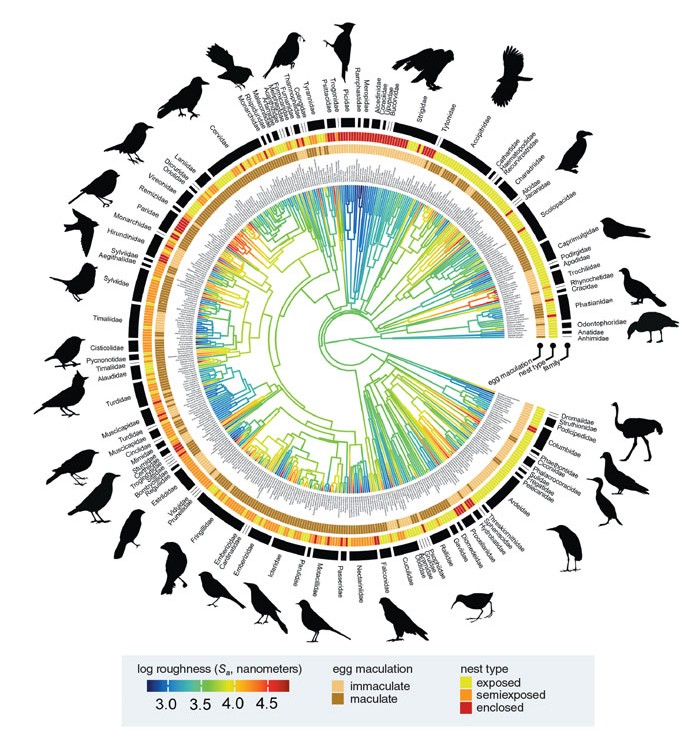
St Hugh’s Tutorial Fellow in Biology, Professor Steve Portugal has recently had his paper entitled ‘Scratching beyond the surface: examining macroecological patterns in avian eggshell texture’ featured in an article published in American Scientist. To determine how the eggs have adapted to withstand their environments, Professor Portugal, his postdoctoral fellow Marie Attard and their team imaged the surfaces of thousands of different bird eggshells from the vast collections of the Natural History Museum and the Western Foundation of Vertebrate Zoology in California. Professor Portugal hopes that deciphering the conditions that drive variation in eggshell structures could help improve captive bird breeding programs, which he says often have poor hatching rates.
The team chose 453 avian species that represented a range of habitats globally, then divided the eggs based on maculation. Maculate eggs have colors, spots, patterns, and intricate designs, whereas immaculate eggs are all white. The researchers further categorised the eggs by nest type: exposed, semiexposed, and enclosed.
Materials engineer James Bowen of the Open University then applied his imaging expertise to visualising eggshell structures on the nanometer scale. Using a profilometer, which is essentially a 3D laser microscope, he scanned small samples of the eggshell surfaces, identifying every peak, valley, divot, and pore.
Professor Portugal said, ‘In science fiction movies, a machine scans someone’s face, and a computer recreates an image of the face on a screen. The profilometer is effectively doing the same thing, but it’s doing it through a microscope.’
The team found that species that lay maculate eggs and build exposed nests typically have rougher eggshell surfaces. The results were similar to what had been found previously for lotus plants (Nelumbo nucifera), which live in muddy bogs in Asia, yet their leaves are never dirty. Profilometry has shown that lotus leaves have lots of peaks and are very rough, so dirty water droplets that fall on the leaf maintain their bubble shape and quickly roll off.
‘We think that eggshells that have this roughness are nested in a more exposed environment and are probably using it for the same reason,’ Professor Portugal explained. ‘It helps keep the eggs clean and stops the pores from being completely saturated when it rains.’
Professor Portugal continued, ‘Without successful eggs, birds will cease to exist. Birds have spent millions of years developing the best possible eggshell structure to maximize the likelihood of surviving in their specialized habitats, and dramatic environmental changes can cause these adapted species to struggle. But understanding the factors to which eggs have adapted could help in preserving habitats where eggs can hatch successfully.
‘Unlike almost every other living thing, eggs can’t move, but they have to cope with so much.’
