20 October 2026
St Hugh’s Sports Fellow wins gold at Rotary Cycling World Championships
Congratulations to St Hugh’s Sports Fellow Professor Horst Eidenmüller
Read More
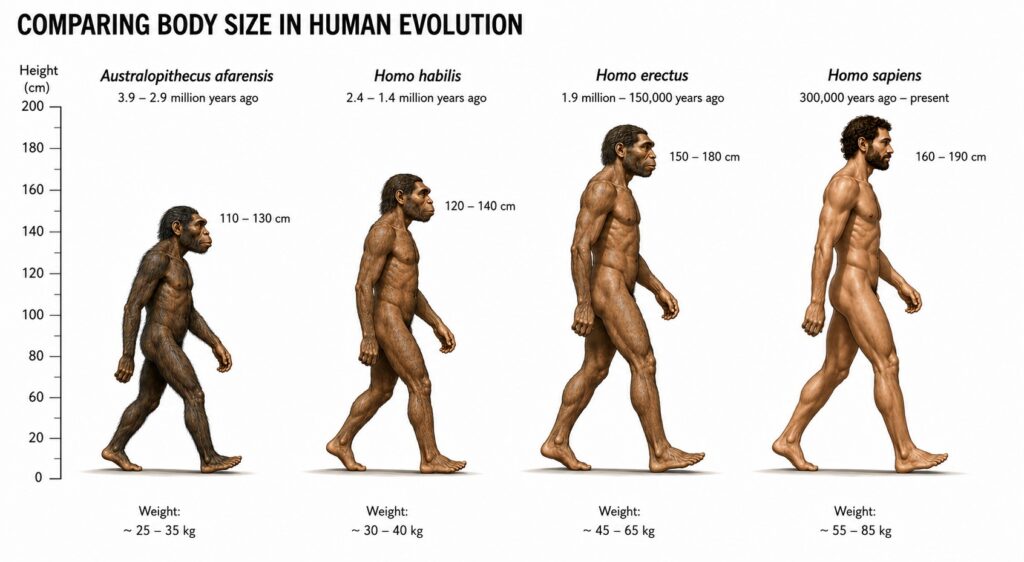
New research published in the journal PNAS on 22 June 2026, co-authored by Professor Thomas Püschel, St Hugh’s Tutorial Fellow in Human Sciences and Associate Professor in Evolutionary Anthropology at the School of Anthropology and Museum Ethnography at Oxford University, looks at how body size evolved in the human lineage and challenges the traditional idea that our ancestors gradually became larger over time. Instead, it shows that while early hominins remained relatively small, there was a more abrupt increase in body size later on, around 2–2.5 million years ago with the emergence of species such as Homo erectus. It also highlights that human evolution was not a simple linear process: some lineages remained small, and different branches of our family tree followed very different trajectories.
The findings show that some species bucked the trend completely. Homo floresiensis and Homo naledi stayed small, with the early hominin Australopithecus weighing 40kg, on average, and reaching the height of a child. Other branches of Homo grew larger. Homo erectus/ergaster were the first hominins to weigh around 60kg or more, on average, achieving weights similar to many modern humans.
Researchers from the University of Oxford and University of Reading reached these conclusions by looking at body weight from 386 fossils across 21 different species of hominins, the group that includes humans and our extinct relatives. They used statistical models to track how body size changed over millions of years.
Dr Thomas Puschel said: “Our results suggest that human body size evolution was not simply a story of steady growth over time. Although body mass generally increased throughout our evolutionary history, the most significant shift occurred later within the genus Homo. This change coincided with broader developments in how our ancestors moved across landscapes and exploited their environments, pointing to a close relationship between body size and major ecological and behavioural transitions.”
To read the full research article please click here.
