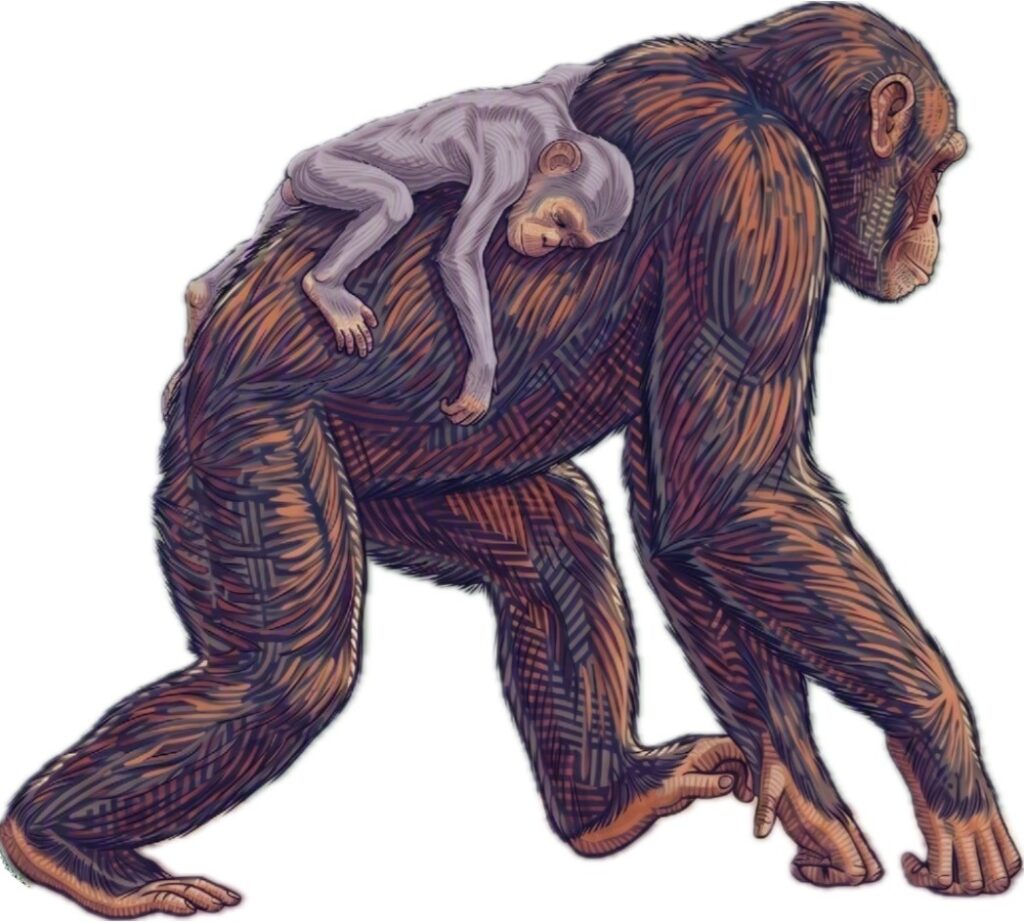
New research by St Hugh’s Fellow explores why some chimpanzee mothers carry their dead infants for months
Research by Professor Thomas A. Püschel, St Hugh’s Tutorial Fellow in Human Sciences and Wendy James Associate Professor in Evolutionary Anthropology, and doctoral candidate Reece Hammond published in Biology Letters, finds that carrying is likely driven by the strong bond between chimpanzee mothers and their offspring, and that the cause of an infant’s death is the most consistent explanation for how long its mother carries it. Importantly, these patterns need not mean mothers recognise death as final.
Chimpanzee and bonobo mothers sometimes continue to carry their infants after they have died, a behaviour known as infant corpse carrying (ICC). It is widely documented, and many explanations have been proposed, but few have been quantitatively tested.
The research found that infants that were older when they died, and therefore more closely bonded with their mother, were carried for longer than younger infants and that infants who died from disease were carried for longer than those that died through infanticide.
The study brought together data from 83 published cases of ICC across 15 different sites. The cases document mothers that carried their dead infants for only about 30 minutes, through to periods as long as 126 days. The average ICC duration was about 11 days.
Chimpanzees and bonobos are our closest living relatives. Most experts think our last common ancestor lived between 6 and 8 million years ago, and studying death-related behaviours in these species may provide key insights into the evolutionary origins of human responses to death.
Professor Püschel said, ‘Our findings show that we don’t need to assume that chimpanzee and bonobo mothers understand death as irreversible to explain how long they carry their dead infants. The patterns can be explained by the persistence of maternal behaviour and by social, life-history and environmental factors, but importantly, that does not mean these animals are incapable of recognising death.’
To view the original paper please click here.